
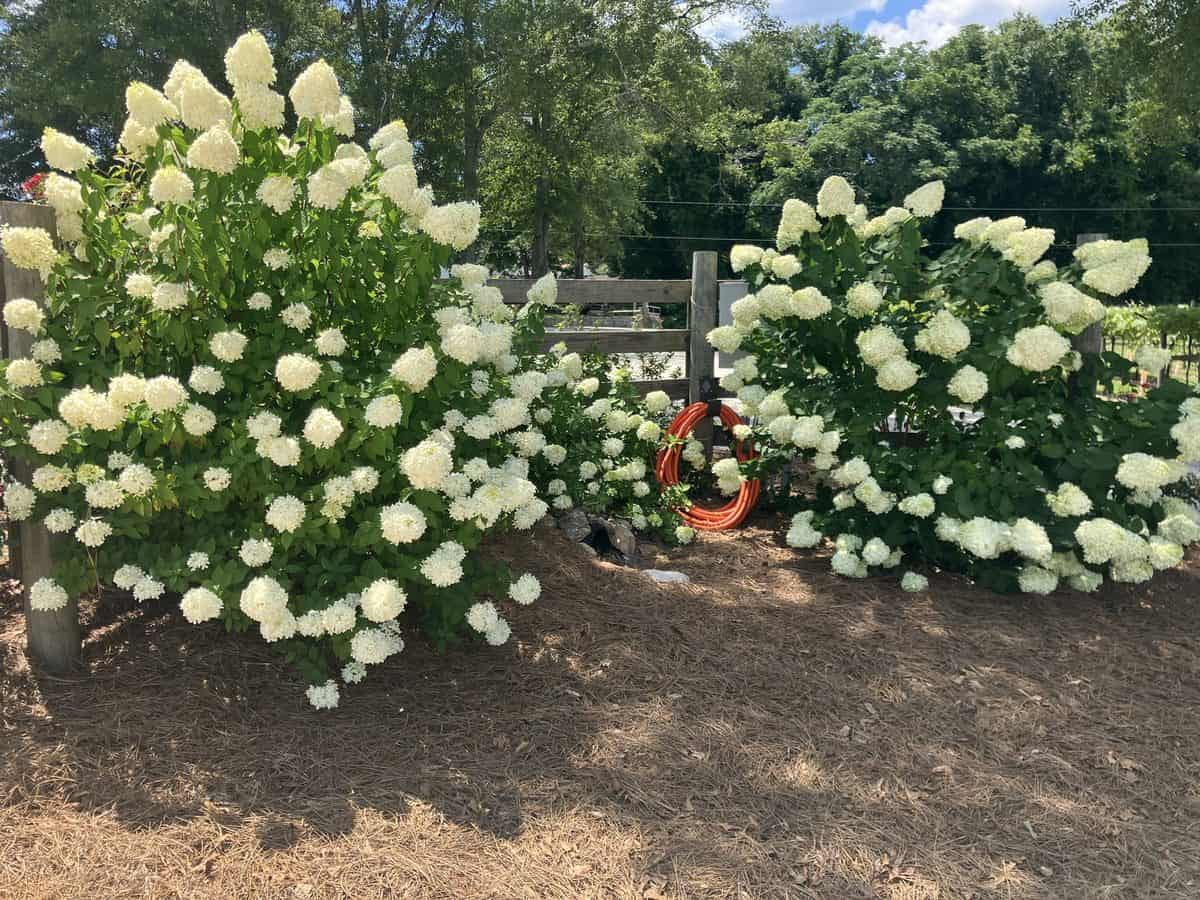
Most flowering shrubs in the South are done by August. The azaleas finished in April, the gardenias quit in July, and what is left in the beds is a lot of green. Limelight hydrangea starts blooming right about the time everything else gives up, and it holds its flowers until frost.
That timing is the whole reason it ended up in my yard, and in about half the yards on my street. It is also the plant people get wrong the most, usually by treating it like the blue hydrangea their grandmother grew.

It is a panicle hydrangea, not the blue kind
Limelight is Hydrangea paniculata. The blue and pink mopheads most people picture are Hydrangea macrophylla, and almost nothing you know about those applies here.
The flowers are cones, not balls. The color has nothing to do with soil pH, so there is no point buying aluminum sulfate and no risk of it going a muddy pink on you. It takes far more sun than a bigleaf ever would. And most importantly, it blooms on new wood, meaning this year’s growth produces this year’s flowers.
That last one is the single most useful fact about this plant, and I will come back to it when we get to pruning.
Zones 3 through 9, which is unusual
Limelight is rated hardy from zone 3a to 9b. That is a wider range than almost any other flowering shrub you can buy, and it means a gardener in northern Minnesota and a gardener in north Florida are growing the same plant.
What changes across that range is not whether it survives. It is how much sun you give it. At the cold end, cold is the limiting factor. At the warm end, in zones 7, 8 and 9, heat is the limiting factor, and that changes where you should put it.
How much sun it actually wants
The tag will say full sun to part sun. Full sun means six hours or more. Part sun means four to six. Both are technically correct, which is why the tag is not very helpful.
The rule that matters is simpler: full sun in cold climates, afternoon shade in warm ones. If you garden in zone 7 or below, plant it where it gets sun most of the day. If you are in zone 8 or 9, give it morning sun and shade from about two o’clock on. A wall, a fence line, or the east side of a taller shrub all work.

You can tell when it is getting too much. The flower heads brown at the edges early and go papery instead of turning pink, and the leaves wilt every afternoon even when the soil is damp. Too little sun looks different: fewer and smaller panicles, and stems that lean instead of standing up.
Where to plant it
A mature Limelight is six to eight feet tall and just as wide. Space them seven to eight feet apart. The most common mistake I see is one planted three feet off a foundation, where in four years it either swallows a window or gets sheared into a green box every spring.
Give it room and it does several jobs well. It anchors the corner of a bed. It makes a loose, informal hedge along a fence. It fills the back of a mixed border where perennials are starting to fade in August. If you want to build a whole bed around one, we walk through that in our guide to planning a year-round Limelight hydrangea landscape. In my back bed it sits next to a purple loropetalum, and the dark foliage behind the pale green flower heads does more for both plants than either does alone.

The one thing it will not tolerate is wet feet. Well-drained soil is not a suggestion with panicle hydrangeas. Avoid the low spot in the yard where water stands for a day after a hard rain. If that is the only place you have, build the bed up six or eight inches first.
The pruning rule that decides your whole season
Because Limelight blooms on new wood, you prune it in late winter or early spring, before it breaks dormancy. February into early March works across most of the South.
Cut it back by about one third of its total height. That is it.
This is the part that makes the plant so forgiving. With a bigleaf hydrangea, pruning at the wrong time means you cut off every flower bud and get a summer of leaves. You cannot do that to a Limelight. Prune it in spring and it grows new stems and blooms on them the same year.
People sometimes ask why one third instead of cutting it to the ground. Hard pruning does work, but it gives you fewer, much larger flower heads on stems that have not had time to thicken. Those are exactly the stems that end up on the ground after the first August thunderstorm. One third keeps the frame and keeps the heads a size the plant can hold up.
The flowers change color on their own
This is the part that surprises people who have only seen it in a catalog photo.
The panicles open a soft celadon green, which is where the name comes from. They lighten to cream and near white at peak. Then, as the nights start cooling in September and October, they shift to pink, then rose, then a deep burgundy, and they hold that color through the first frosts.

One shrub gives you three distinct looks in a single season, and none of it requires anything from you. Do not deadhead in fall. The dried heads are the best thing in the bed in November.
Stems flop, and the tag will not tell you
This is the honest complaint about Limelight and the one you should know going in. A panicle soaked with rain is heavy, and young plants in particular will bow under them. Tree-form Limelights, the ones grafted onto a single trunk, are the worst about it.
Some of it is unavoidable. Most of it you can manage. Give it more sun rather than less, since shade-grown stems are thinner and weaker. Do the one-third spring prune instead of a hard cut. Go easy on high-nitrogen fertilizer, which pushes soft growth. And give it two or three years to build woody stems before you decide it is a problem. Most plants that flop badly in year one stand up fine in year three.
If you know from the start you cannot give it that much room or that much time, there is a better answer than fighting it.
When eight feet is too much, look at Little Lime
Little Lime is the compact version of the same plant, holding at roughly three to five feet instead of six to eight. Same green to cream to pink progression, same new wood pruning, same wide zone range.

It fits the places Limelight does not: a low hedge along a walk, a large container, a small courtyard bed, the front of a border rather than the back. The shorter stems also mean noticeably less flopping.
Garden center signs often market it as the more drought tolerant option, and it is a tough plant once settled. I would not lean on that in year one or two. Every hydrangea, panicle types included, will wilt in a dry August, and a new shrub still needs a deep soaking once a week through its first two summers.
Cutting them for the house
They are good cut flowers and even better dried ones.
For a vase, cut in the morning and strip the leaves off the stem. For drying, wait until late in the season when the heads have started to turn color and feel papery rather than soft. Cut them then, stand them in a vase with an inch of water, and simply let the water evaporate. They hold their shape and most of their color for months, which is more than you can say for most things you dry.
Plant one this fall, prune it lightly next spring, and by the following August you will have the only thing in the yard still blooming.